The era of viewing the Arctic as a pristine, cooperative geopolitical periphery is over. Driven by receding sea ice and the compounding vulnerabilities of global energy supply chains, the Arctic has rapidly transformed into a primary theatre of great power competition in 2026. This zero-sum contest for maritime routes, hydrocarbons, and critical minerals is not only pitting the Sino-Russian axis against the West, but is also severely fracturing the internal cohesion of the NATO alliance.
Russia’s Infrastructure Hegemony and the EU Paradox
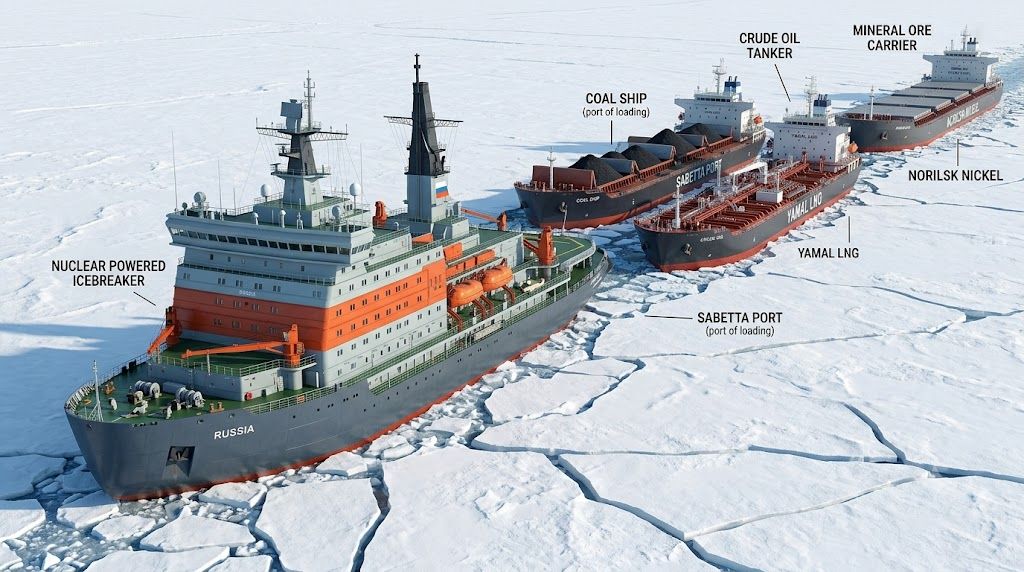
While Western policymakers have focused heavily on other theaters, Russia has cemented its dominance over the High North. Satellite intelligence from July 2026 confirms the scale of Moscow’s dual-use infrastructure build-out along the Northern Sea Route. This includes expanded deep-water ports at Sabetta and Dudinka, upgraded air bases, and the continuous expansion of the world's largest icebreaker fleet, featuring exclusive nuclear-powered vessels.
Crucially, this northern hegemony exposes a glaring contradiction in Western sanctions policy. As Europe scrambled to replace Russian pipeline gas, its reliance on seaborne Liquefied Natural Gas (LNG) surged. In the first half of 2026 alone, the European Union paid an estimated $6.82 billion for Yamal Arctic LNG. This paradox means that European energy insecurity is directly subsidizing the Russian state budget and, by extension, Moscow's ongoing militarization of the polar corridor.
China’s 'Polar Silk Road' Probing Tactics
Beijing is systematically normalizing its presence in the Arctic, leveraging its self-declared status as a "near-Arctic state." In July 2026, the U.S. Coast Guard tracked the Chinese research vessels Xue Long and Xue Long 2 transiting through the U.S. Exclusive Economic Zone (EEZ) in the Bering Sea.
This deployment—part of a massive four-vessel polar expedition—mirrors China's initial probing tactics in the South China Sea: utilizing ostensibly scientific and research operations to establish a persistent presence, map strategic seabeds, and calibrate signal intelligence without provoking a direct military confrontation.
The Greenland Standoff and NATO's Internal Fracture
The most destabilizing element of the 2026 Arctic crisis originates from within the NATO alliance. Driven by the imperative to secure supply chains for rare earth elements and counter Sino-Russian encroachment, the United States administration took unprecedented unilateral action. In January 2026, the introduction of the Greenland Annexation and Statehood Act in Congress, accompanied by executive demands to bring the autonomous Danish territory under American control, triggered a systemic rupture.
By redefining Arctic governance as a unilateral zero-sum contest rather than a collective alliance responsibility, Washington challenged the post-World War II norms underpinning NATO. The firm rejections from Denmark and the Greenlandic government, backed by major European powers, exposed a deep transatlantic rift.
Conclusion: A Zero-Sum Polar Order
The Arctic is no longer insulated from global geopolitical friction. The standoff over Greenland, coupled with the Sino-Russian militarization of the Northern Sea Route, demonstrates that control over polar logistics and critical minerals is now viewed as an existential national security imperative. For defense planners and energy markets alike, the lesson of 2026 is clear: the thawing of the Arctic has frozen the prospects for polar cooperation, giving rise to a highly militarized and fiercely contested northern frontier.