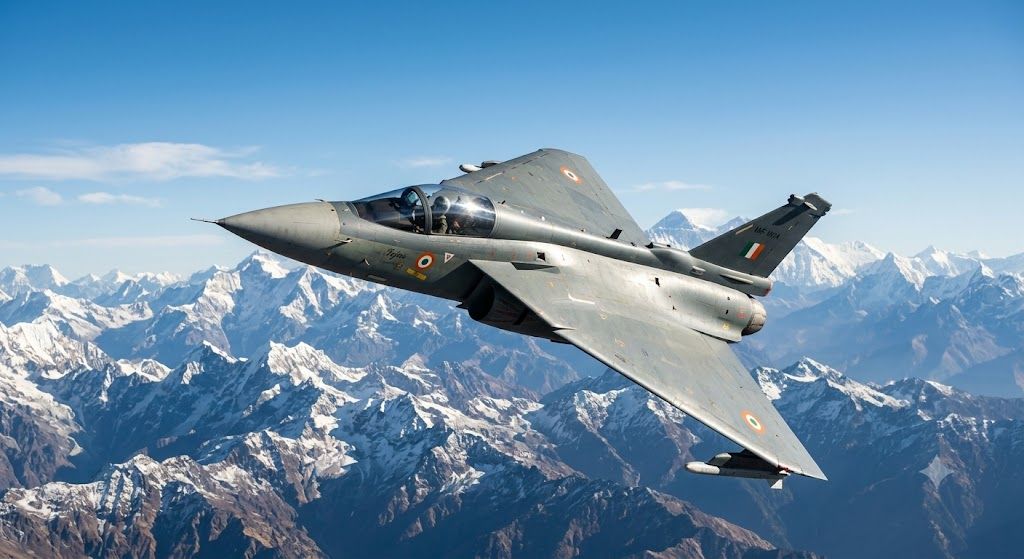
The Shift in Airborne Sensor Procurement
Astra Microwave Products Limited (AMPL) has secured a ₹2,205.23 crore contract from Hindustan Aeronautics Limited (HAL) to supply 122 Airborne Active Antenna Units (AAAU) and 121 Interface Frames for the Uttam Active Electronically Scanned Array (AESA) radar. Scheduled for execution over a five-year period, this procurement marks a definitive pivot in India’s defense aerospace sector. It signals the maturation of the indigenous combat sensor ecosystem, finalizing the transition from imported radars to a domestic supply chain for the Tejas Mk1A fighter fleet, and structurally altering the technological autonomy of the Indian Air Force (IAF).
Evolution of the Uttam Program
Historically, India’s airborne fire-control radar capabilities have relied heavily on foreign suppliers, predominantly Israel and Russia. Early iterations of the Light Combat Aircraft (LCA) Tejas, operating in Initial and Final Operational Clearance (IOC/FOC) configurations, were equipped with the Israeli-origin EL/M-2032 mechanically scanned radar. The initial batch of 83 Tejas Mk1A fighters integrated the Israeli EL/M-2052 AESA radar.
The Uttam program, led by DRDO’s Electronics and Radar Development Establishment (LRDE), was initiated to break this dependency cycle. After over a decade of iterative development, testing on modified aircraft, and integration validation, this 122-system order confirms that the Uttam has successfully navigated the "valley of death" between prototype development and scaled production. It will directly support the expanded production run of the Tejas Mk1A, following the Defense Acquisition Council's clearance for an additional 97 airframes.
Enhancing Combat Capability
At its core, the Uttam Mk-1 is a solid-state, Gallium Arsenide (GaAs)-based AESA radar housing 912 Transmit/Receive Modules (TRMs). Unlike legacy mechanically scanned arrays, an AESA system utilizes electronic beam steering. This provides multi-target tracking, superior reliability (due to the absence of moving parts), and a Low Probability of Intercept (LPI), making the emitting aircraft harder for adversaries to detect.
Operationally, the Uttam provides a detection range of approximately 150km against tactical targets. It supports simultaneous air-to-air, air-to-ground, and maritime modes, including Synthetic Aperture Radar (SAR) imaging and ground moving target indication (GMTI). In modern beyond-visual-range (BVR) combat and dense electronic warfare (EW) environments, the agility of the Uttam’s quad-band stacked modules affords the Tejas Mk1A enhanced resistance to jamming and improved situational awareness.
Autonomy in the Sensor Domain
The strategic importance of this acquisition cannot be overstated. A fighter aircraft is ultimately a delivery platform for its sensors and weapons; controlling the source code and hardware of the primary sensor equates to true strategic autonomy.
By replacing foreign systems, India eliminates the risk of end-user restrictions, sanctions, and supply chain disruptions during geopolitical crises. This order directly benefits the Indian military apparatus by granting them total control over software upgrades, electronic warfare libraries, and integration protocols for future indigenous weapons (such as the Astra family of air-to-air missiles). The clear losers in this shift are legacy foreign suppliers—specifically Israeli Aerospace Industries (IAI/Elta)—who will see a lucrative, captive market for mid-tier fighter sensors significantly contract.
Scaling the Domestic Ecosystem
The ₹2,205 crore contract represents a watershed moment for the Indian defense industrial base. The traditional framework—where DRDO develops technology and HAL integrates it—is now firmly supported by a highly capable private sector manufacturer.
For Astra Microwave, this contract transitions the firm from a supplier of complex microwave subsystems to a scaled manufacturer of high-ticket AAAU systems. It retains critical capital within the domestic economy, creates high-value engineering employment, and strengthens the lower-tier MSME supply chains that provide components for the TRMs and liquid cooling systems. Furthermore, standardizing the Uttam across a large fleet ensures long-term maintenance, repair, and overhaul (MRO) revenue remains onshore.
Execution and Integration
Despite the strategic win, professional assessment requires acknowledging the friction points ahead.
1. Production Velocity: Astra Microwave must sustain a production rate that perfectly aligns with HAL’s ambitious Tejas Mk1A delivery schedules (targeted at 24 aircraft per year). Any bottleneck in the AAAU supply chain will directly delay fleet induction.
2. Component Dependency: While the radar is indigenously designed, the global semiconductor supply chain remains volatile. Securing steady access to raw materials for GaAs-based Monolithic Microwave Integrated Circuits (MMICs) is critical to avoiding production stalls.
3. Operational Maturity: As the Uttam enters squadron service, it will inevitably face teething issues in complex, multi-ship EW environments. The speed at which DRDO and Astra Microwave can patch software and refine hardware based on frontline IAF pilot feedback will dictate the program's ultimate success.
The Baseline for Future Air Dominance
The 122-system order is not the endpoint; it is the baseline. The architecture of the Uttam is scalable. Successful execution of this contract validates the technology for future iterations, including the Uttam Mk2 for the Tejas Mk2 and the Twin-Engine Deck-Based Fighter (TEDBF), as well as advanced derivatives for the Advanced Medium Combat Aircraft (AMCA).
Furthermore, a proven, domestically produced AESA radar drastically improves the export viability of the Tejas platform. Unencumbered by third-party intellectual property restrictions, India can now offer a highly competitive, sensor-independent fighter package to emerging markets in Southeast Asia, the Middle East, and Africa. The Uttam AESA procurement proves that India's defense indigenization is moving beyond import substitution toward sovereign capability generation.