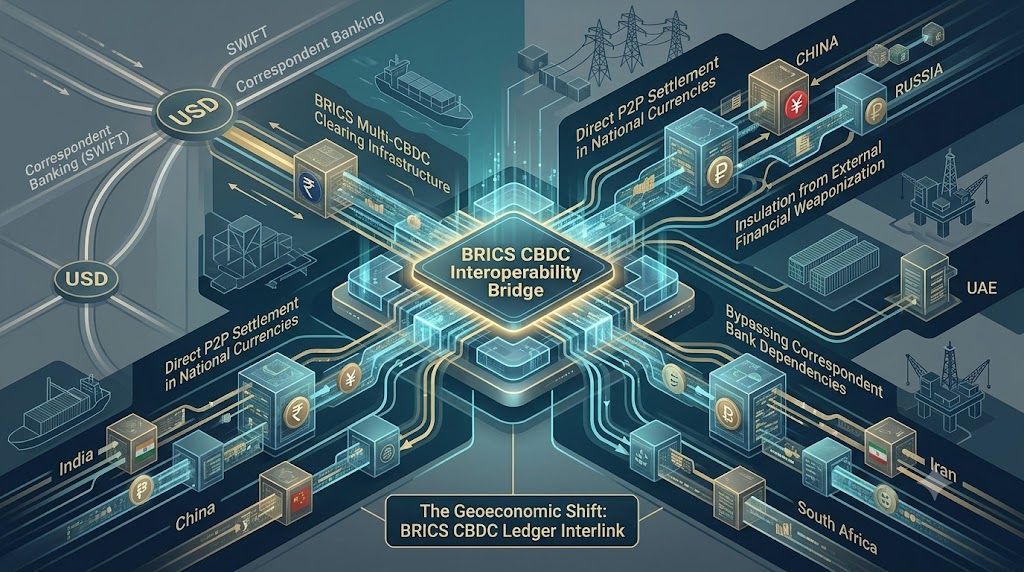
For decades, the concept of "de-dollarization" has been dismissed by Western economists as geopolitical theater. However, ahead of the 2026 BRICS Summit hosted by India, the rhetoric has transitioned into actionable, digital infrastructure. The Reserve Bank of India’s (RBI) recent proposal to interlink the Central Bank Digital Currencies (CBDCs) of BRICS member states marks a structural shift in global finance. It signals a coordinated effort by the Global South to build an alternative, sanction-proof financial highway that fundamentally bypasses the U.S. dollar and Western clearing houses like SWIFT.
The 2026 BRICS Agenda: From Rhetoric to Infrastructure
When India assumed the presidency for the 2026 BRICS Summit, the bloc had already expanded to ten members (including major energy powers like the UAE, Saudi Arabia, and Iran), representing roughly 45% of the global population and 36% of global GDP based on purchasing power parity.
While the 2025 Rio Summit focused heavily on broad declarations regarding local currency settlements, New Delhi’s 2026 agenda is aggressively pragmatic. The RBI’s proposal aims to create a multi-currency digital clearing infrastructure. Instead of attempting the politically impossible task of creating a single "BRICS currency" to rival the dollar, the strategy relies on creating interoperability between existing sovereign CBDCs—such as India's Digital Rupee (e₹), China’s e-CNY, and Russia's Digital Ruble.
The Mechanics of Bypassing SWIFT
The technological blueprint for this shift is already proven by initiatives like Project mBridge—a collaborative multi-CBDC platform involving China, the UAE, Thailand, and the BIS.
Under the current SWIFT system, cross-border trade between two BRICS nations (e.g., India purchasing oil from the UAE) typically requires converting rupees to dollars, and dollars to dirhams, utilizing U.S. correspondent banks. This exposes both nations to U.S. Federal Reserve monetary policy, transaction fees, and the ever-present threat of secondary sanctions.
The proposed BRICS CBDC interlink operates on a peer-to-peer distributed ledger. It enables direct, near-instantaneous settlement in national currencies using smart contracts. By removing the dollar as the intermediary vehicle currency, BRICS nations immediately achieve lower transaction costs, faster settlement times, and total insulation from U.S. financial weaponization.
Geopolitical Friction: The E-CNY vs. The Digital Rupee
While the strategic logic of bypassing Western financial hegemony is unifying, the internal mechanics of a BRICS digital bridge are fraught with friction.
The primary geopolitical tension lies between New Delhi and Beijing. China’s e-CNY is currently the most advanced and widely tested wholesale CBDC in the world. India is acutely aware that integrating its financial architecture too deeply with Chinese infrastructure risks merely replacing dollar dependency with yuan dependency. Therefore, the RBI’s proposal emphasizes interoperability over a centralized system, ensuring that the Digital Rupee retains strict sovereign parameters without being subsumed by Chinese technological standards.
Conclusion: Hedging at Scale
The U.S. dollar will not lose its status as the world’s primary reserve currency in the near term; it still accounts for the vast majority of global foreign exchange reserves and trade invoicing.
However, the 2026 BRICS CBDC initiative proves that the era of unchallenged dollar dominance is eroding at the margins. What we are witnessing is not a revolutionary overthrow of the greenback, but financial hedging at scale. As emerging economies successfully operationalize these digital payment corridors for South-South trade, the geopolitical leverage that Washington wields through the traditional SWIFT system will be permanently diminished.