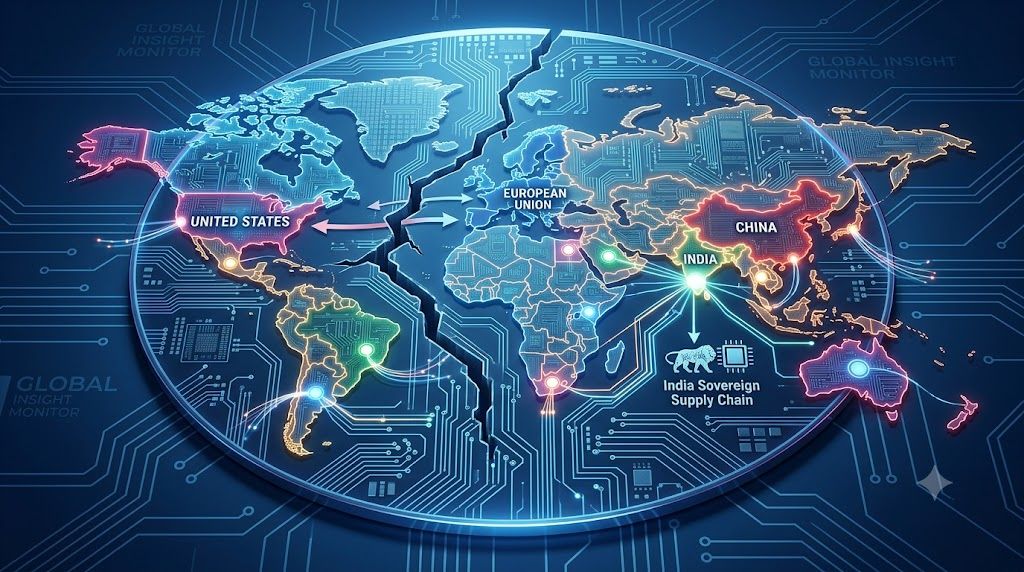
The era of laissez-faire globalization is definitively over, replaced by a ruthless era of "techno-nationalism." Throughout 2026, the fusion of national security and industrial policy has accelerated, fundamentally reshaping the global economic order. Advanced technologies—specifically mature and advanced node semiconductors, generative artificial intelligence, and cloud infrastructure—are no longer viewed merely as commercial products. They have been reclassified as vital instruments of state power. This paradigm shift is actively fracturing the global digital landscape, forcing multinational corporations and middle powers to navigate an increasingly polarized, zero-sum geopolitical environment.
The Tri-Polar Tech Fracture: US, China, and the EU
The architecture of the global internet and its underlying hardware is splitting into distinct, heavily regulated spheres of influence.
In Washington, transactional diplomacy and aggressive economic interventionism have become the bipartisan standard. The U.S. government is increasingly utilizing targeted export controls, revenue-sharing restrictions, and quasi-nationalization tactics to choke off adversarial access to advanced silicon and AI compute. Concurrently, Beijing is accelerating the development of a completely closed, sovereign digital ecosystem, effectively insulating its domestic tech architecture from Western sanctions while aggressively subsidizing its legacy-node semiconductor production to flood the global market.
Meanwhile, the European Union is attempting to carve out its own regulatory digital sovereignty. Driven by the imperative to reduce reliance on American hyperscalers (like AWS and Microsoft) and Chinese hardware, Brussels is erecting complex compliance and localization barriers, putting it on a direct collision course with both Washington and Beijing.
The Middle Power Play: India’s Sovereign Supply Chain
As the major powers decouple, strategic "swing states" are aggressively capitalizing on the realignment of global supply chains. India serves as the primary blueprint for this hedging strategy.
In July 2026, New Delhi formally approved the "Semicon 2.0" initiative, a massive second-generation semiconductor mission backed by a ₹1.27 lakh crore state outlay. Coupled with the recent inauguration of the CG Semi Outsourced Semiconductor Assembly and Test (OSAT) facility in Gujarat, India is actively transitioning from a passive consumer of foreign technology to an integrated node in the global semiconductor value chain. By simultaneously subsidizing domestic rare-earth permanent magnet manufacturing—crucial for EVs and aerospace—India is strategically reducing its dependency on Chinese critical minerals while offering Western firms a de-risked manufacturing alternative.
The Weaponization of Foundational AI
Beyond hardware, the geopolitical frontline has expanded into the algorithms themselves. Generative AI has transitioned from an experimental enterprise tool into a mechanism of sovereign soft power and ideological influence.
Because foundational AI models inherently reflect the data and systemic biases of their creators, they are becoming battlegrounds for narrative control. Western models often reflect distinct ideological leanings, while Chinese systems are strictly tethered to state-approved narratives. Consequently, nations across the Global South are increasingly viewing reliance on foreign AI models as a direct threat to their cultural and political sovereignty, driving a surge in state-sponsored, localized LLMs (Large Language Models) designed to protect domestic data and linguistic heritage.
The Corporate Dilemma: The End of the Stateless Multinational
For global business leaders, the strategic implications of this fracture are profound. The concept of the "stateless multinational corporation"—operating friction-free across borders—is no longer viable.
Accessing foreign markets in 2026 requires navigating a labyrinth of competing technical standards, data localization demands, and conflicting security compliance regimes. Corporations operating in strategic sectors are now forced to make a binary choice: align intimately with the political and security objectives of their host nation, or face exclusion, punitive regulations, and targeted tariffs.
Conclusion: Security Over Efficiency
The techno-nationalist policies defining 2026 are not temporary trade disputes; they represent a permanent structural reorganization of the global economy. The supply chains of the next decade will be dictated by national security, redundancy, and geopolitical alignment, rather than pure cost-efficiency. As governments cement their roles as major players in the corporate arena, the nations and businesses that survive this transition will be those that master the complex intersection of silicon, sovereign data, and statecraft.