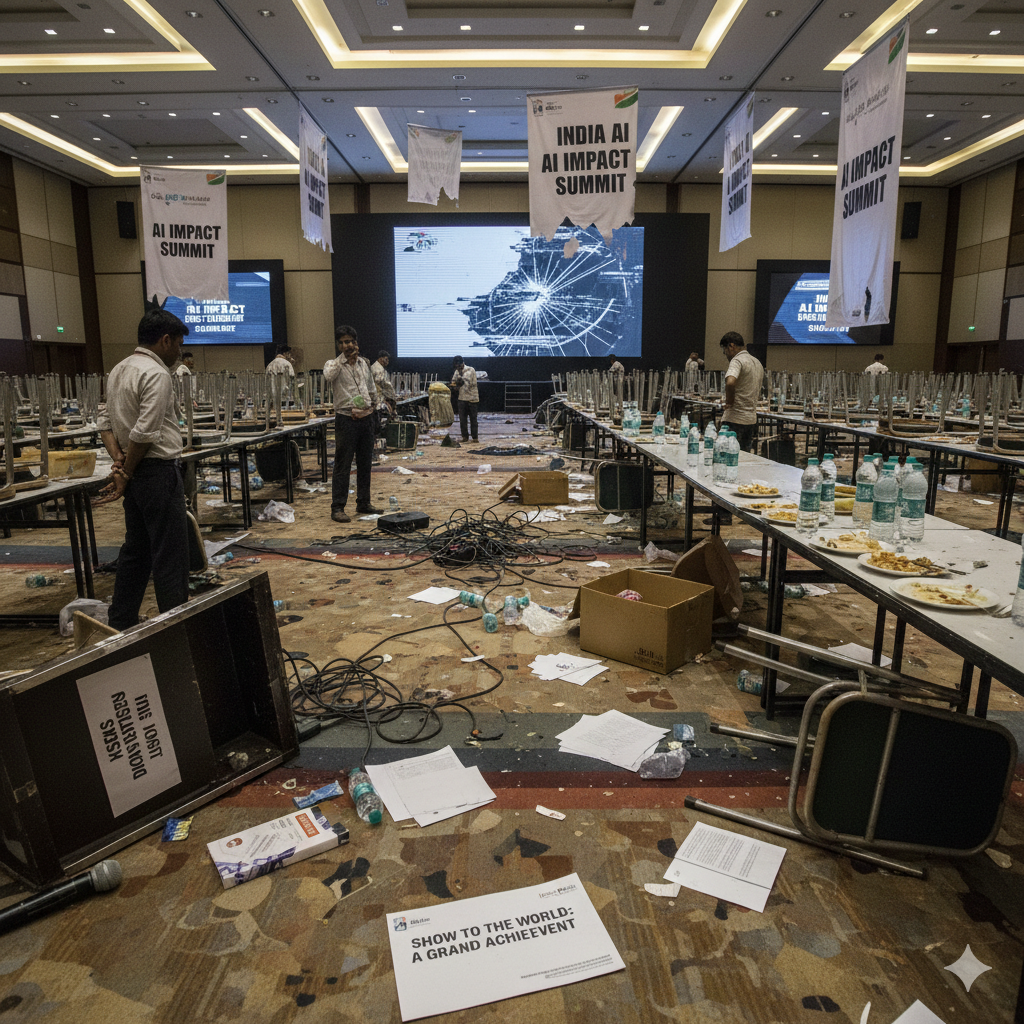
The Global South Mandate vs. Execution Reality
The India AI Impact Summit, held in New Delhi in February 2026, was envisioned as a geopolitical inflection point. As the first major artificial intelligence summit hosted by a Global South nation—following exclusive gatherings at Bletchley Park, Seoul, and Paris—New Delhi sought to position itself as the bridge between Western technological monopolies and developing economies. Anchored by the ambitious "IndiaAI Mission," the summit was designed to shift the global discourse away from existential safety risks and toward applied AI for economic development.
On paper, the convening power was undeniable. The presence of heads of state alongside industry titans such as Google’s Sundar Pichai, OpenAI’s Sam Altman, and DeepMind’s Demis Hassabis provided the ideal stage. Yet, rather than cementing India’s leadership in global AI governance, the summit’s potential was severely diluted by institutional mismanagement and organizational friction.
Optics Over Governance: The Trade Fair Critique
The primary failure of the summit lay in its execution. Instead of fostering high-level, multilateral policy frameworks—structured around the government's touted "Three Sutras" (People, Planet, Progress)—the event devolved into what industry observers characterized as a disorganized trade fair.
Attendees and international delegates reported significant logistical bottlenecks, fractured scheduling, and an overemphasis on the 300-exhibitor India AI Impact Expo at the expense of substantive closed-door diplomacy. More damaging to India's credibility were the controversies surrounding the exhibition itself, including verified reports of non-Indian AI products being misrepresented as indigenous innovations. In a diplomatic environment where trust and transparency are the currencies of technology transfer, these unforced errors raised serious questions about the organizing committee's oversight and accountability.
Ecosystem Milestones Amidst the Noise
Despite the administrative chaos, it is vital to separate the event's mismanagement from the genuine momentum of India's domestic AI ecosystem. The summit did serve as a launchpad for significant sovereign capabilities.
Crucially, the government announced a commitment to scale the IndiaAI Compute Portal, adding 20,000 GPUs to its existing base of 38,000 to democratize compute access for domestic startups. On the product front, the launch of the government-backed BharatGen Param2—a 17-billion parameter multimodal model supporting 22 Indian languages—demonstrated tangible progress in overcoming the linguistic barriers that define Global South markets. Furthermore, private sector advancements, such as Sarvam AI's rollout of new large language models and hardware prototypes, underscored that India's foundational engineering base remains robust, even if state-sponsored showcases falter.
The Strategic Cost of Mismanagement
The mismanagement of the 2026 AI Impact Summit serves as a stark strategic lesson for New Delhi. As the global AI market races toward a projected multi-trillion-dollar valuation by the end of the decade, technological leadership cannot be claimed through sheer demographic scale or high-profile photo opportunities alone.
India possesses the digital public infrastructure (DPI), the human capital, and the developmental use-cases—from precision agriculture to predictive healthcare—to genuinely lead the Global South. However, to translate this potential into geopolitical leverage, future initiatives must match the sophistication of the technology they seek to govern. India cannot afford to squander its convening power on superficial spectacles when the architecture of the future global digital economy is actively being written.