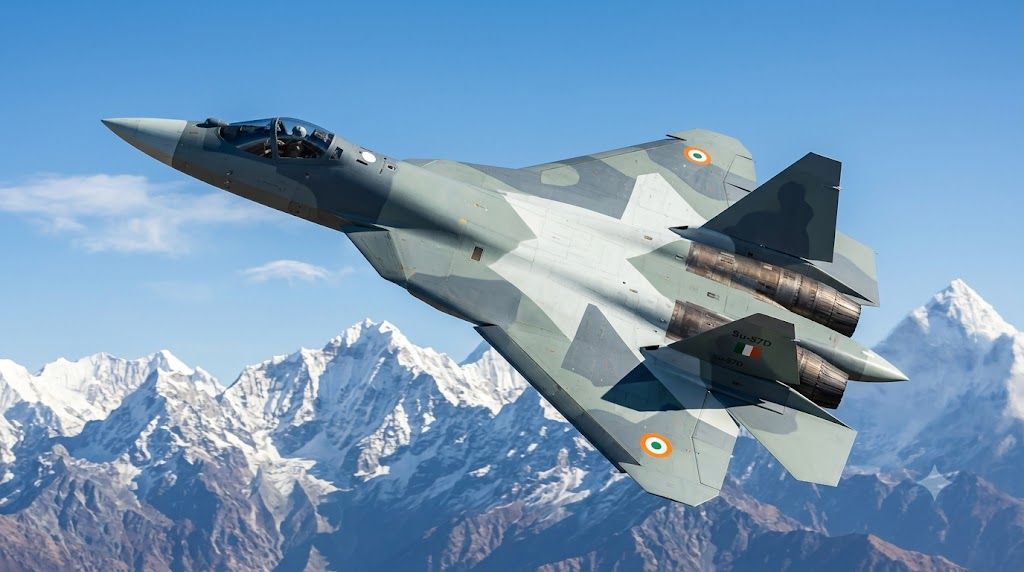
For over a decade, Indian defense procurement has been heavily anchored to the concept of acquiring 114 Medium Role Fighter Aircraft (MRFA). However, the fundamental calculus of regional air superiority has shifted dramatically. As China rapidly scales its fifth-generation fleet and Pakistan prepares to induct similar capabilities, committing tens of billions of dollars to 4.5-generation fighters risks equipping the Indian Air Force (IAF) for yesterday's wars. To maintain parity in the 2030s, a strategic pivot toward the Russian Su-57 platform and a massive expansion of ground-based air defense systems represents the most pragmatic path forward.
The Rapidly Closing Window
The numerical and technological imbalance along India's borders is accelerating. Recent satellite imagery confirms that China has deployed its upgraded J-20 stealth fighters to the Hotan and Damxung airbases near the Line of Actual Control (LAC). While the IAF relies heavily on the highly capable Rafale, it faces a severe vulnerability gap.
The indigenous Advanced Medium Combat Aircraft (AMCA) program, meant to provide India's sovereign stealth capability, is unlikely to deliver operational squadrons before 2035. By the time any new MRFA jets arrive, the combined Chinese and Pakistani fifth-generation fleets—comprising the J-20 and the anticipated Shenyang FC-31 (J-35)—could exceed 700 airframes.
The 4.5 Generation Fallacy
Acquiring 114 non-stealth fighters does not fundamentally address a battlespace dominated by low-observable technologies and advanced beyond-visual-range (BVR) sensors. While 4.5-generation platforms offer robust electronic warfare suites and formidable payload capacities, they inherently lack the stealth characteristics required to penetrate contested airspace defended by modern integrated air defense networks. Purchasing fourth-generation technology for a fifth-generation threat environment effectively cedes the technological high ground before the conflict begins.
The Su-57 Proposition and Technology Transfer
A viable stop-gap measure has emerged through advanced negotiations with Moscow. In June 2026, Russian President Vladimir Putin formally proposed a joint production deal for the Su-57 stealth fighter to India.
This is not merely a vendor-buyer relationship. The Russian Defence Ministry has reportedly made an unprecedented offer to provide full access to the aircraft's source code. A new variant tailored to IAF requirements, the Su-57D, successfully completed its first flight in May 2026. To facilitate this, Hindustan Aeronautics Limited (HAL) assessed that roughly 50 percent of its existing Russian equipment manufacturing facilities could be utilized for producing this fifth-generation aircraft.
To bridge the immediate vulnerability window, defense planners are considering an initial "off-the-shelf" procurement of at least two squadrons (roughly 36 to 40 fighters). This would rapidly inject fifth-generation capabilities into the IAF while domestic license-production lines are established.
The Air Defense Imperative
If bridging the stealth fighter deficit faces fiscal or bureaucratic delays, capital must be aggressively reallocated to asymmetric countermeasures. The ultimate equalizer against stealth aviation is a saturated, multi-layered air defense network.
India is currently developing the indigenous "Sudarshan Chakra" air defense system, which will incorporate elements from the Russian-origin S-400 missile defense network. Underscoring the urgency of this approach, New Delhi cleared the procurement of an additional five S-400 systems in March 2026, which will expand the planned total to ten. Beefing up these ground-based interceptors provides a highly cost-effective deterrence against adversary stealth incursions, shifting the burden of risk squarely back onto hostile penetrating fighters.