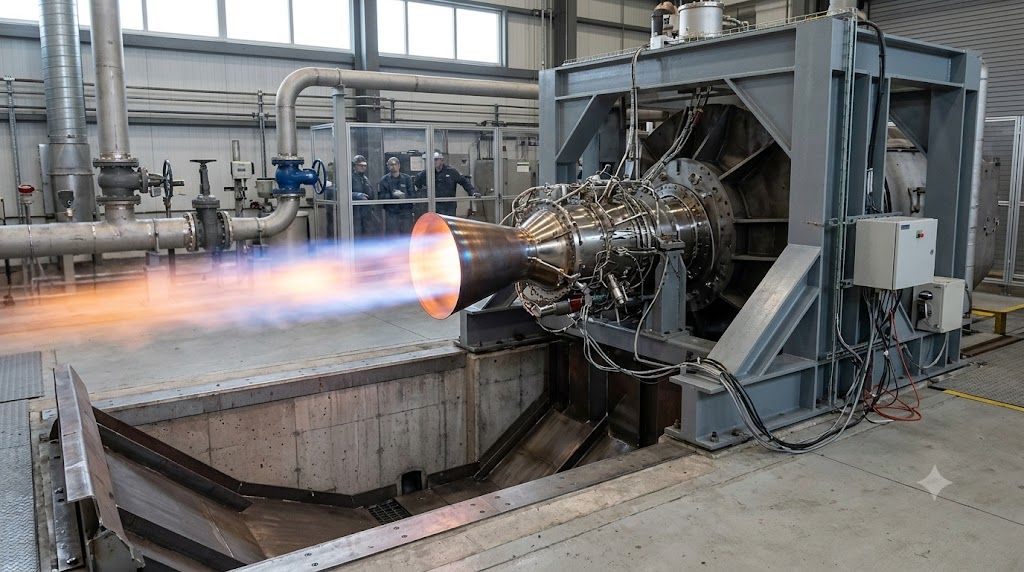
A Shift in Aerospace Propulsion
On July 21-22, 2026, Indian defense propulsion startup D-Propulse successfully conducted a hot-fire demonstration of the country's first indigenous 5 kilonewton (kN) air-breathing Rotating Detonation Engine (RDE). Integrated with an aerospike nozzle and tested at a Defence Research and Development Organisation (DRDO) facility, the engine achieved stable thrust and officially reached Technology Readiness Level 5 (TRL-5). This milestone marks the critical transition of next-generation pressure-gain combustion from laboratory-scale experiments to an integrated prototype operating in a relevant environment. It signals a structural leap in India’s capability to field faster, more efficient supersonic cruise missiles and high-speed unmanned aerial vehicles (UAVs).
The journey for Sustained Supersonic Flight
Historically, high-speed propulsion has relied on conventional gas turbine engines (turbojets/turbofans) or ramjet/scramjet technologies. While effective, conventional turbines suffer from thermodynamic limitations and require complex, heavy moving parts. Scramjets, conversely, require the vehicle to already be traveling at supersonic speeds before they can ignite.
Incubated at IIT-Madras and chaired by former DRDO Chief Dr. Vijay Kumar Saraswat, D-Propulse was established to bridge this gap. Achieving TRL-5—meaning the technology works safely alongside realistic supporting systems under real-world aerospace test conditions—confirms that India’s domestic private sector is now complementing DRDO’s scramjet and ISRO’s reusable launch vehicle programs.
Efficiency Through Detonation
The technical leap represented by the D-Propulse engine lies in its architecture. Unlike conventional jet engines that rely on deflagration (subsonic combustion), an RDE utilizes continuous detonation waves traveling at supersonic speeds around an annular channel. This "pressure-gain combustion" yields a 15% to 25% higher thermodynamic efficiency compared to traditional air-breathing systems.
Crucially, the prototype was integrated with an aerospike nozzle rather than a traditional bell nozzle. Bell nozzles are optimized for a specific altitude; an aerospike automatically compensates for changing atmospheric pressure, maintaining thrust efficiency from sea level to high altitudes. For a cruise missile designed to fly low to evade radar and high to maximize range, this adaptability is a rare and highly sought-after capability globally.
Pacing the Global Threat Environment
The successful 5 kN burn validates continuous engine operation at a thrust class equivalent to a small cruise missile. Strategically, this positions India among an elite subset of nations moving RDE technology out of the laboratory.
By mastering air-breathing RDEs, India can field sustained supersonic flight platforms without carrying heavy oxidizers. This directly translates to longer-range interceptors and lighter, faster cruise missiles that shrink the reaction time of adversary air defense networks. In a geopolitical landscape where speed dictates survivability, replacing conventional propulsion with detonation engines provides a distinct tactical overmatch.
Simplifying the Supply Chain
Beyond thermodynamics, the RDE disrupts traditional defense manufacturing. Conventional turbines require highly complex, metallurgically advanced turbine blades and extensive moving parts, creating supply chain bottlenecks.
Because the RDE combustor features zero moving parts, it dramatically simplifies engine architecture. According to D-Propulse, these engines can be manufactured through precision machining rather than complex turbine assemblies. This shifts the industrial requirement away from heavily monopolized global turbine suppliers toward domestic precision manufacturing MSMEs, drastically reducing both production costs and lead times.
The Path to Flight Qualification
While TRL-5 is a formidable achievement, the "valley of death" in defense procurement lies between prototype and flight qualification.
1. Thermal Management: Sustaining multi-second pressure-gain combustion generates extreme acoustic and thermal loads. Scaling the engine for longer flight durations will severely test domestic material sciences and cooling technologies.
2. Integration: Mating an RDE to an existing or developmental airframe requires managing complex aerodynamic shockwaves at the air intake, a notoriously difficult engineering challenge.
3. Timeline Execution: D-Propulse has set an aggressive target to have a flight-ready engine by December 2027. Any delays in subsequent ground testing or raw material procurement could push this timeline into the next decade.
A Benchmark for Domestic Defense Tech
The 5 kN RDE test proves that deep-tech innovation in India is no longer the exclusive domain of state-owned enterprises. The prototype tested was not a mere laboratory demonstrator, but the proof motor for a flight-capable design. As D-Propulse advances toward its 2027 flight-ready target, this engine architecture will serve as the baseline for a new generation of Indian target drones, high-speed UAVs, and sovereign cruise missiles.