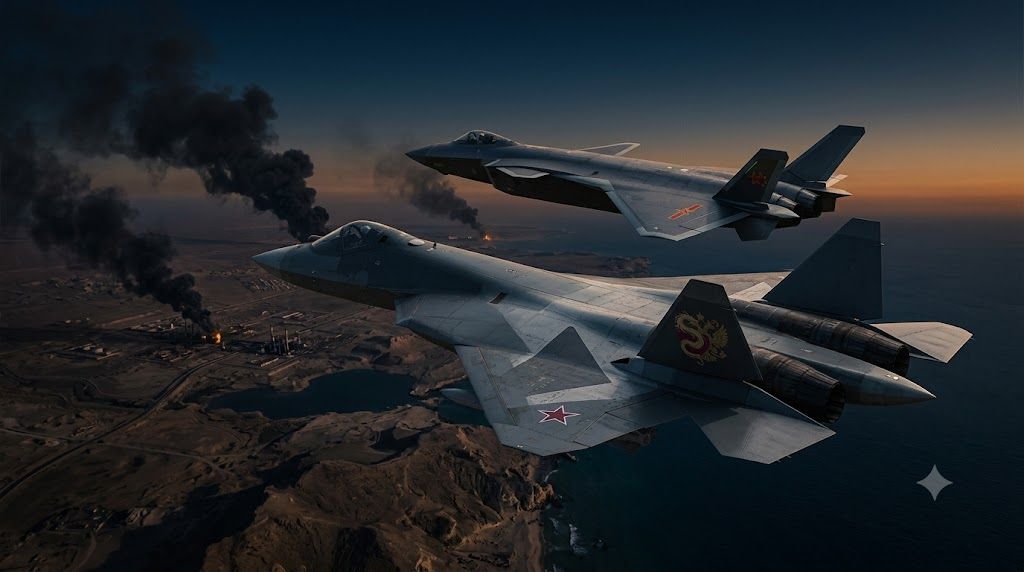
The potential for a direct United States military intervention against the Islamic Republic of Iran remains a pivotal concern for global stability. While much analysis focuses on the immediate regional consequences, the broader strategic implications lie in the reactions of the two powers that have increasingly positioned themselves as Iran's primary patrons: China and Russia. An American military strike against Iran could serve as a definitive red line for Beijing and Moscow, triggering a systemic rupture that would rapidly consolidate an anti-Western strategic bloc and reshape international relations.
The Chinese Calculus: Energy Security and the Belt and Road
For Beijing, the relationship with Tehran is not merely transactional; it is a critical pillar of its grand strategy. Iran serves as a vital geographic node in the Belt and Road Initiative (BRI), designed to project Chinese economic influence across Eurasia while circumventing maritime choke points controlled by the U.S. Navy. More importantly, Iran is a crucial guarantor of China's energy security, providing the petroleum necessary to fuel its domestic economy.
A U.S. attack on Iran would directly threaten these core interests. It would disrupt essential energy supplies and jeopardize billions in Chinese infrastructure investments. In response, Beijing's reaction would likely extend beyond diplomatic condemnation. China could rapidly escalate its support for Iran, potentially through increased economic lifelines or the covert transfer of advanced defensive technologies. Furthermore, anticipating a protracted U.S. entanglement in the Middle East, Beijing might leverage the distraction to assert a more aggressive posture in its own near abroad, particularly in the South China Sea, calculating that Washington lacks the bandwidth to manage two simultaneous major theater conflicts.
The Russian Calculus: Military Ties and Asymmetrical Leverage
Russia’s strategic calculus regarding Iran is equally complex, rooted in historical military cooperation and a shared opposition to U.S. hegemony. Moscow views Iran as a critical counterweight to American and allied influence in the Middle East, having supplied Tehran with advanced military hardware and diplomatic support for its nuclear program.
An American strike would likely prompt Moscow to significantly bolster its military posture in the region. This could involve expedited deliveries of advanced air defense systems (such as the S-400) or increased naval deployments in the Persian Gulf to project power and complicate U.S. operational planning. Beyond direct support, Russia would almost certainly use the crisis to accelerate its efforts to forge a united front of nations seeking to bypass Western financial systems and sanctions regimes, solidifying an "Axis of Evasion" designed to insulate its members from U.S. coercive diplomacy.
The Escalation Matrix and Global Ramifications
The immediate aftermath of a U.S. strike would not be confined to state-on-state conventional conflict. The risk of regional escalation is extreme, given Iran's established doctrine of asymmetric warfare and its extensive network of proxy forces. Retaliation would likely manifest through coordinated attacks on U.S. assets, allied infrastructure (particularly energy facilities in Saudi Arabia and the UAE), and sophisticated cyber offensives.
Moreover, the international response would severely stress existing alliances. European nations, long advocates for a diplomatic resolution to the Iranian nuclear issue, would face immense pressure, potentially fracturing transatlantic unity. Within international forums such as the United Nations, Russia and China would wield their veto power to block any US-led resolutions, transforming the Security Council into an arena for geopolitical gridlock.
Conclusion: A Catalyst for Multipolarity
In summary, a U.S. military strike on Iran would transcend the immediate theater of operations, acting as a catalyst for deeper global polarization. For China and Russia, such an action would confirm the necessity of a solidified, alternative geopolitical bloc. The ensuing conflict would likely accelerate the transition away from a unipolar world order, forcing Washington to confront a highly integrated, revisionist axis capable of imposing significant costs on U.S. global interests.