The illusion of a swift resolution to the 2026 Iran war has entirely evaporated. The collapse of the July 8 ceasefire and the subsequent resumption of hostilities between the United States, Israel, and Iran mark a dangerous new phase in a conflict that has fundamentally rewired the geopolitics of the Middle East. Five months after the initiation of Operation Epic Fury—the joint US-Israeli decapitation strike that assassinated Supreme Leader Ali Khamenei—the conflict has devolved into a grinding, multi-front war of attrition that is inflicting unprecedented structural damage on the global economy.
The Collapse of the Diplomatic Off-Ramp
For a brief period in early summer, a diplomatic off-ramp appeared viable. The June 17 memorandum of understanding signed by the US and Iran was designed to end the dual naval blockades in the Persian Gulf. However, the foundational grievances driving the conflict—namely, Washington's imperative to dismantle Iran’s nuclear capabilities and Tehran’s reliance on its regional proxy network for survival—remained wholly unaddressed.
The inevitable collapse of this agreement in July demonstrates that neither side possesses the political capital or the strategic desire to capitulate. Iran’s swift internal reorganization following Khamenei's death—with figures like Ali Larijani moving rapidly to stabilize the regime—proved that the Iranian state apparatus was far more resilient to decapitation strikes than Western war planners anticipated. Instead of collapsing, Tehran decentralized its strategy, mobilizing its "Axis of Resistance," including the Popular Mobilization Forces (PMF) in Iraq and Hezbollah in Lebanon, ensuring the conflict remained a theater-wide conflagration.
The Chokepoint War and the Economic Shockwave
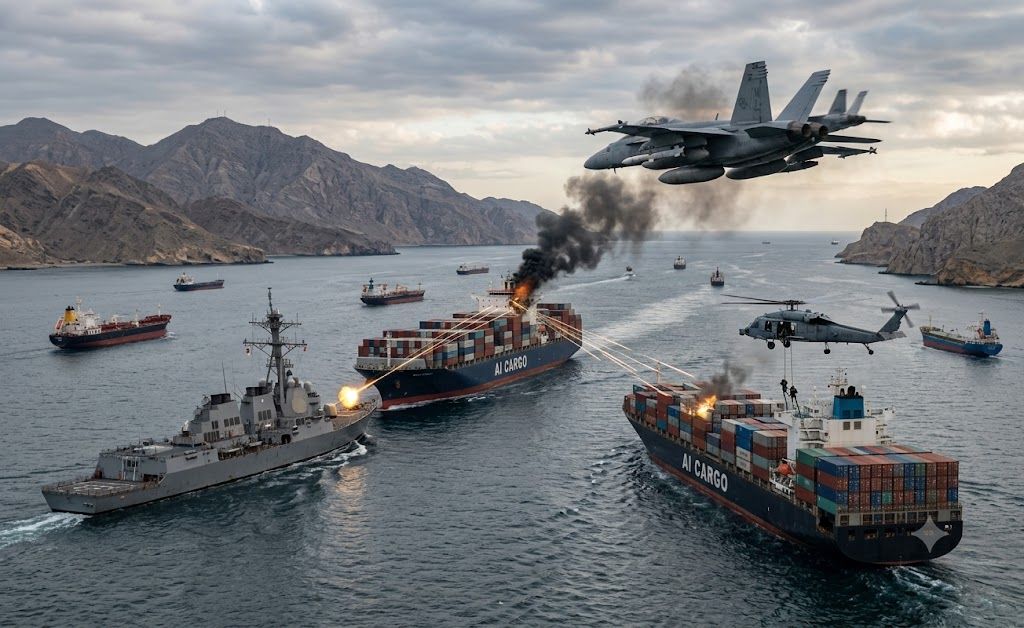
The most defining characteristic of this war is not the exchange of ballistic missiles, but the weaponization of geography. Iran’s blockade of the Strait of Hormuz has triggered what the International Energy Agency describes as the "greatest global energy security challenge in history."
This chokepoint warfare has essentially paralyzed the economies of the Gulf Cooperation Council (GCC). Because over 80% of the GCC's caloric intake relies on maritime transit through the Strait, the blockade triggered a concurrent "grocery supply emergency," forcing nations to airlift basic staples at exorbitant premiums. Furthermore, the crisis shifted from a macroeconomic disruption to a looming humanitarian catastrophe following Iranian strikes targeting regional desalination plants—the source of 99% of drinking water for states like Kuwait and Qatar.
Globally, the macroeconomic fallout is staggering. The conflict has echoed the 1970s energy crisis, introducing severe supply shortages, intense currency volatility, and the very real specter of stagflation across Western economies. While crude prices have seen wild volatility—initially surging past $120 a barrel before fluctuating wildly as markets react to geopolitical rumors and US domestic political pressure—the long-term structural damage to global supply chains is already priced in.
The Permanent Fracture of Gulf Security
Beyond the immediate tactical exchanges, the 2026 war has permanently destroyed the narrative of the Persian Gulf as a permanently safe haven for foreign investment and expatriate capital. The vulnerability of glittering financial hubs to regional crossfire has been starkly exposed.
As the U.S. administration requests record-setting Pentagon budgets to sustain a war that had already cost Washington over $113 billion by June, the Middle East is facing a grim reality. The post-1990 American security umbrella in the Gulf is no longer an absolute deterrent; it is merely one faction in a sprawling, multi-polar conflict. The resumption of fighting in July guarantees that the region will remain a heavily militarized, high-risk operational environment for the foreseeable future, forcing global markets to permanently adjust to the loss of Middle Eastern stability.